Par Alice – Le 05 Mai 2026
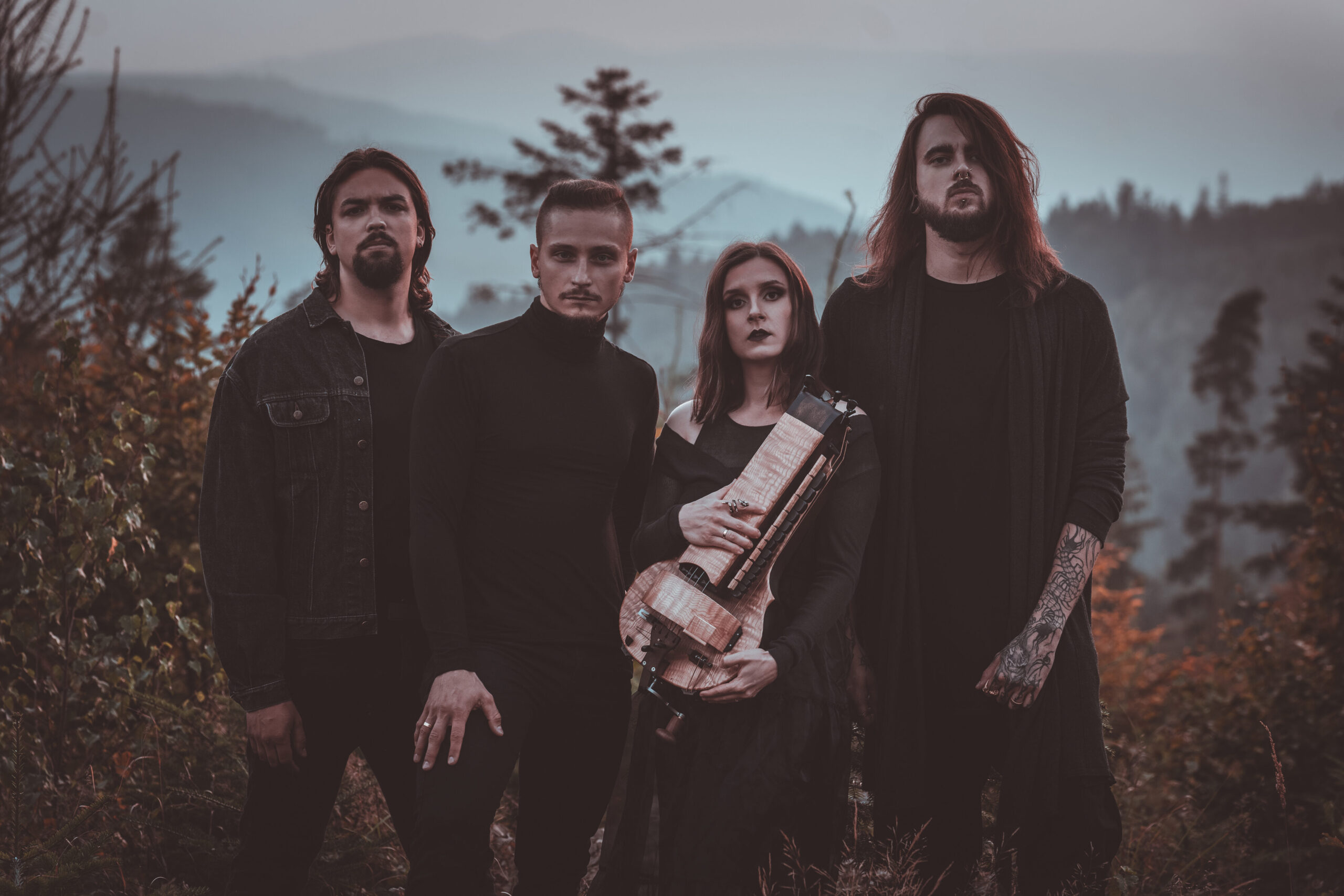
Three years after their debut, Poland’s LYRRE are back with Nothing Is Promised. This second album reveals a more mature sound, showcasing a bold and organic Folk/Prog identity. From self-production to artistic growth, Piotr and Michalina take us behind the scenes of this new record’s creation.
To begin with, we can feel a much stronger identity on this new one, with a more assertive modern Folk/Prog sound compared to your first record which seemed more exploratory. Was this a shared intention from the start, or is it the natural result of your recent compositions?
Piotr: We feel that this stronger sense of identity started to take shape while we were finishing some of the last songs for the previous, including “Valley of Tears” and “Chariot of Sun”. Around that time, we also began to recognize certain distinctive elements that we wanted to define LYRRE’s sound on the next release.
I think the songwriting workflow we developed towards the end of the previous album also played an important role in shaping this new style. Everything starts with a few rough song ideas, built around several riffs with a similar mood and a basic drum arrangement. Michalina then goes through these drafts and selects the ones she finds the most promising, before writing the lyrics, vocal lines and hurdy-gurdy parts.
This way, each song becomes a unique combination of two different perspectives: mine and Michalina’s.
Your debut involved collaboration with Noah Sebastian (Bad Omens). What did you learn from that experience that influenced your decision to handle the production of this second differently?
Piotr: Our collaboration with Noah was one of the key lessons for us, both in terms of songwriting and music production. It is hard to put into words, but the way Noah reworked and enriched our demos gave us a certain intuition for how to build and release tension in order to guide the listener through different stages within a single track.
It only took four songs from the previous album co-written with Noah for us to feel confident enough to produce the rest of the tracks ourselves, giving them a more distinctly personal character.
As a result, when we began the creative process for the second, we felt much more confident. We also already had a certain vision in mind of how we wanted it to sound – shaped both by the lessons we had learned from the first and by a slight shift in our musical inspirations for the second album.
Michalina: When we were writing our first record, we felt much more inspired by music production in the electronic/pop context. We loved how Noah used these influences in his own music with Bad Omens and that’s why we chose him as our dream co-producer. Once we started songwriting for “Nothing Is Promised”, we noticed that the compositions naturally gravitated toward a more organic and raw sound. We simply followed that path, later on adding a different kind of production, focused more on choirs, guitar and hurdy-gurdy layering, instead of synths and samples.
You continue to evolve as a self-produced band. Is this independence essential to protect your artistic vision, or is it a process that simply fits your way of working better?
Piotr: We do not really have a good point of comparison when it comes to releasing albums through a label, or how much labels influence the creative process these days. We suspect that the key difference might be the pressure labels can put on artists to work faster on an album or release singles more frequently.
In our case, we had the comfort of deciding for ourselves how much time we needed to get everything exactly where we wanted it, without any compromises – especially artistic ones.
Thanks to the successful crowdfunding campaign for our debut one, we managed to get LYRRE moving strongly enough to cover the entire process of producing, releasing and promoting the second ourselves.
The album’s theme suggests a darker, perhaps more philosophical reflection on the uncertainty of the future. Can you tell us more about the central concept of « Nothing Is Promised »?
Michalina: I would say the concept of “Nothing Is Promised” developed very naturally and we were only able to see it by looking at the finalized production. It wasn’t something we decided on upfront. When I’m writing my melodies and lyrics, I always try to follow the music itself, matching its intensity and atmosphere. And since the songs we selected for this album were quite dark and moody, it inspired the lyrics and shaped my vocals. However, I also feel like the uncertainty of life is something that I reflect on quite often, so it finds a way into my lyrics across this.
The track « ORCHARD » was released long before the rest. Was it ready before the others, or did it represent the perfect gateway to introduce the atmosphere of this record?
Piotr: “Orchard” was the first song from the new album to be mixed. We also felt it was a strong track to introduce the record, as it showcases a wide range of musical landscapes and sonic textures – from punchy, groovy riffs to atmospheric interludes.
There was one track that had been composed and recorded much earlier than the rest of the album: “The Well”. However, in order to make it fit sonically with the rest of the record, it was mixed last.
We also felt that “The Well” had a more epic, conclusive character, so we preferred to let it see the light of day a little later.
‘Ephemeral’, I think, is a key point on this album, centered on that unique hurdy-gurdy solo: how did you craft this organic sound to build tension toward that majestic final chorus? »
Piotr: The solo in “Ephemeral” was entirely Michalina’s vision – almost like a song within a song. It has a very hypnotising and trance-like character. In a way, its character refers back to the bridge in “Call in the Wind” from the previous one.
We feel that this kind of build-up, made of layered, somewhat minimalist hurdy-gurdy parts that together create intriguing harmonies, forms a unique musical landscape. We are very happy with how it turned out in “Ephemeral”, although it required a very detailed approach to the mix in order to preserve the specific character of the bridge without losing connection with the rest of the song.
It was definitely the most difficult track to mix, and it took a great deal of shared effort and determination from both us and Przemysław Nowak from Impressive Art, who mixed this.
Michalina: When it came to writing the hurdy-gurdy solo for “Ephemeral”, I tried a few different approaches and ideas, some more expressive and complex, some more simple. In the end, we settled on the version that felt the most natural to the track – not flashy or extravagant, but more hypnotic – a melody that grows and develops slowly. To our surprise, some commenters on social media mentioned similarities between “Ephemeral” and Tool – which we really did not expect and are honored to hear!
Tracks like « The Well » and « Oracle » feel very heavy with influences like Black Metal or Prog without losing your signature sound. « The Well » specifically is a headbanger! How do you balance these extreme influences with Lyrre’s melodic identity?
Piotr: We feel that this musical heaviness had been part of LYRRE’s style from the very beginning, but it did not fully develop on the first one. “The Well”, as I mentioned earlier, was the very first song composed for the second album. We were already performing it live during the shows promoting our debut. It is possible that, through those performances, we became more accustomed to a slightly more aggressive sound, and the heaviness of this song became a reference point for the whole record.
The black metal associations are quite fitting here, as my inspirations include bands such as Alcest, Harakiri for the Sky, Mgła and even Behemoth.
Listening this recorded, there’s a real sense of rising tension, and the final tracks seem to hold some surprises. Was the album designed to be experienced as a continuous journey?
Piotr: When writing, we usually try to make each song feel like a journey for the listener, guiding them through different emotional states. Only once the whole production is finished do we try to approach the material with fresh ears and arrange the order of songs into a complete whole – one that forms a closed story.
Michalina, we can hear a real evolution in your vocal approach. Do you feel more confident today exploring new textures, and how are you preparing to perform these new tracks live?
Michalina: I definitely feel more confident with my vocals nowadays. I still have a lot to learn, but I feel like I know my voice much better compared to when we were recording and playing shows promoting the first one. I essentially learned how to sing during that process. It was truly a challenge for me: from getting to know the basic technique, to then recording in the studio and performing live. I needed the most time and patience with live shows, learning how to sing in that changing and demanding environment through trial and error.
At the moment, we are rehearsing for the release shows and one thing is certain – the new material is quite demanding. 🙂 I’m also practicing at home and taking vocal lessons, which gave me a lot of confidence, too.
The artwork and illustrations are once again striking. After several collaborations with Adam Strzelczyk, can we say he has become the « fifth member » of Lyrre through his visual style?
Piotr: Absolutely. We feel that Adam’s distinctive style has, in a way, become an integral part of our project. Even though we have not yet had the chance to meet in person, there seems to be a kind of subconscious understanding between us, and many of Adam’s sketches almost immediately match what we have in mind.
It is also worth mentioning Jan Gajewski, with whom we have created all of our music videos so far. Much like Adam, we feel that he is, in a way, part of LYRRE.
I had known Jan before, and even though video shoots with limited budgets and ambitious artistic visions can be extremely stressful, we have managed to achieve results that satisfied everyone while maintaining a good relationship.
We have no doubt that when we decide to make music videos for the next albums, Jan will be the first person we turn to.
For your latest videos, especially « EPHEMERAL », you moved away from wide-open spaces for more enclosed studio settings. Why this choice of a more intimate, almost « huis clos » aesthetic?
Piotr: The choice of indoor locations for this one was mainly driven by our desire to contrast them with the open-air landscapes from the videos for the previous album, which we had already explored quite extensively.
In a way, those limitations pushed us to be more creative. We had to find ways to make simple, closed spaces feel visually striking, original and fitting for the music.
In the end, we feel that the darker mood of the album and the more introspective lyrics work really well with the visuals we created for the singles.
Now that this new universe is established, what are your plans for the coming months? Can we expect to see you performing this album on stage soon?
Piotr: Yes, to celebrate the release of the new production, we have prepared two special release shows in Poland – in Warsaw and Kraków, where we will perform all of the new material.
After the album is released, we do not intend to slow down. We are planning to share a few more music videos for the new record, and we are also preparing alternative versions of some songs – perhaps even the whole album in a completely new formula.